Thursday, 7 June 2012

The horror of everyday objects

My recently published story 'The Doorbell' is the tale of an everyday object gone bad. There's a long history of horror stories based around innocuous objects and as a writer and fan of the genre I wanted to try my hand at it. Oneof the most famous examples is 'Christine' by Stephen King and it's perhaps no coincidence that King's story of a classic car possessed by an evil spirit was the first horror novel I read as a 12 year old. Screw RL Stine I got straight into the good stuff.
Listing every example of the benign and inanimate demonised in horror would be a fool's errand but here are a few. Note that the titles are often as imaginative as that of The 'Doorbell', making the story or film very much focused on the object:
Cars - 'The Car', 'Christine'
Trucks - 'Duel'
Ambulances - 'The Ambulance'
Dolls - 'Dolls'
Puppets - The 'Puppetmaster' series 
Ventriloquist's dummies - 'Magic', 'Dead of Night'
Televisions - 'Poltergeist', 'The Ring', 'Demons 2', 'The Video Dead'
Tyres - 'Rubber'
Any household object you can think of - The 'Final Destination' series. 

The horror of these tales often comes from the fact that these are things that we have willingly allowed into our homes and welcomed into our lives. They are objects that we trust and that then betray us. The use of such familiar things as a focal point is effective because it makes it easy for the reader/viewer to make a connection with the story. One of the big themes in horror at the start of the modern period (mid-70s onwards) when King and Spielberg were at the heights of their popularity was ordinariness. Following the focus on period horror movies in the 60s (Hammer, Roger Corman's Poe adaptations) and the hysterical, exotic or apocalyptic in the 70s (The Exorcist, The Omen, Dawn of the Dead), 80s horror was often about sinister but localised things happening to normal seeming folk. The families in Poltergeist or King's books are believable and easy to identify with, leading familiar lives until the horrific overwhelms them. This sense of familiarity is often enhanced by references to objects that are known to the audience. King certainly loves to pack his books with brand names and cultural references. I tried to do something similar in The Doorbell. The characters are boringly normal: they bicker, they drink a bit too much, they Sky+ things and eat take always. 
So ordinariness draws the reader in and engages them. The other thing that the demonisation of everyday objects brings though is the opposite. It makes it easy for the reader or viewer to put the horror behind them when the story is over. The cymbal-clapping wind-up toy in King's short story The Monkey is terrifying when you're reading about it. When you put the book down though it's just a toy. Similarly the horror of a story like Christine is of the roller-coaster variety. It's thrilling while it lasts but unlike something like The Exorcist or The Texas Chainsaw Massacre it doesn't linger. It doesn't get under your skin.
I liked the idea of a doorbell as the focal point for my story because it is, on the surface, such a ridiculous notion. So much so, in fact, that unlike conditions like "fear of men with beards" (Pogomophobia), "fear of long words" (Hippopotomonstrosesquipedaliophobia) or "fear of losing an erection" (Medomalacuphobia) there doesn't seem to be a word for it. 
Doorbells, however, can be alarming and annoying when they ring unexpectedly. Just like the shrill ring of the telephone the doorbell can interrupt intimate moments. Unlike the phone though it's very hard to ignore. When someone rings your doorbell there's always a fear that they'll know you're in. More so than ever with the advent of mobiles it is acceptable to ignore the ring of the phone. Mobiles are often set to silent or calls rejected out of hand in the knowledge that the caller can leave a message. A knock on the front door is harder to ignore, even if you know it's someone you don't want to talk to. Opening your front door to someone is a trusting, symbolic gesture, in opening the door you are giving your visitors access to your world. Indeed the motif of monster asking for or trying to enter homes is a common one in scary stories. From the wolf in the Three Little Pigs, through vampires having to be granted admission, to Jack Nicholson in The Shining and the zombies in Night of the Living Dead. The home is very important in horror, representing the normality that the monsters of the story are trying to destroy amd as noted above, the ring of a doorbell intrudes into that space even if no physical invasion takes place.

Wednesday, 6 June 2012

Preview of Camera/Phone

It's become something of a habit/tradition for me to post a preview of new stories when I get to the point where I feel they're going somewhere.

Here then, for your reading pleasure, is the opening of my latest effort, 'Camera/Phone'. Enjoy.


Jim was a vicious cunt, prided himself on it in fact, but even he was shocked when he saw the pictures from the phone. The kids who had found it had snatched it off some yuppie walking down the street. He'd been happily tapping away on it. Twitter or Facebook or some shit like that, and they'd had it out of his hands and away in the blink of an eye.
Why people felt the need to be in touch with each other every fucking second of the day escaped him. He spent most of his time trying to avoid people, another way for them to get hold of him was the last thing he needed. Christ, he'd chuck his mobile in the bin if it wasn't so important for his business. That was how the kids had found him today. Or at least how he'd come to hear that they were looking for him, he didn't give his number out to every spotty prick roaming the streets nicking and trying to make a name for themselves.
Danny had texted him. Danny was trusted with his number. He was one of the good guys.
The text said some kids had been to see him and they had something Jim might be interested in. A phone. He mentioned their names in the text, Alexi and Jackson, but Jim didn't know them from Adam. He was shit with names though so maybe he did know them.
He called Danny back, his fat fingers made texting a pain and talking was more his style anyway.
"Dan, what the fuck do I want with a phone? I've already got one. If it's worth something just sell it and give me the cash."
"No Jim. It's not the phone, it's what's on the phone. Pictures, mate. The kind of pictures someone would pay a lot of money to hush up. Let me send you a sample."
Jim hung up and waited for a second and then his phone vibrated and beeped to let him know he had a message. He didn't have one of those posh smartphones. Just an old Nokia, but it had a colour screen and showed photos well enough. When he opened the picture he almost wished it didn't. Still, Danny was right, there might be some money to be made from this.

Alexi was bricking it. Jim Watson had a reputation for toughness and he liked to reinforce it every once in a while by having the shit kicked out of some unfortunate pleb who displeased him. Of course Alexi and Jackson hadn't done anything to displease him but from what Alexi had heard that didn't always stop him. Having any sort of dealings with Watson was bad news as far as he was concerned. There might be rewards but the risks involved far outweighed them. If it had been down to Alexi they'd never have approached him, but of course Jackson had other ideas, as she so often did. "This is our chance, brah," she said. "This is just the kind of thing that twisted old fucker likes. That rich cunt we took it off has serious wedge." She pronounced it Sirius like the binary star system know as the the Dog Star. Only she said it like a snake would say it, lengthening the s's into two sibilant hisses. Not for the first time Alexi wondered why he hung around with her. Then he looked at her tits and remembered.

Monday, 4 June 2012

Dear Suzanna is finished

I posted a preview of this story a while ago thinking it would be wrapped up soon after and then hit a brick wall on it. That wall was soundly smashed this weekend and I rattled through the rest of it. The result is something I'm very happy with, a complete departure from Sunliner and something of a tribute to two legends of the horror genre, George A Romero and H.P. Lovecraft.

It's available free on Smashwords with all major formats supported. A Kindle edition should be up on Amazon in the next day or so.

Smashwords
Edit: Kindle edition is now available
Amazon UK
Amazon US

I'm also quite pleased with the cover.

Sunday, 3 June 2012

The 87th Precinct Project update 1

The first book is in!
Thanks to a very kind tweep I have, completely free of charge, a paperback copy of one of the last books in the series (and one I don't think I've read), The Big Bad City.


Buy Sunliner for non-Kindle devices (iOS, Kobo, Sony Reader)
Buy Sunliner for Kindle (UK)
Buy Sunliner for Kindle (US)


The 87th Precinct Project - the full list

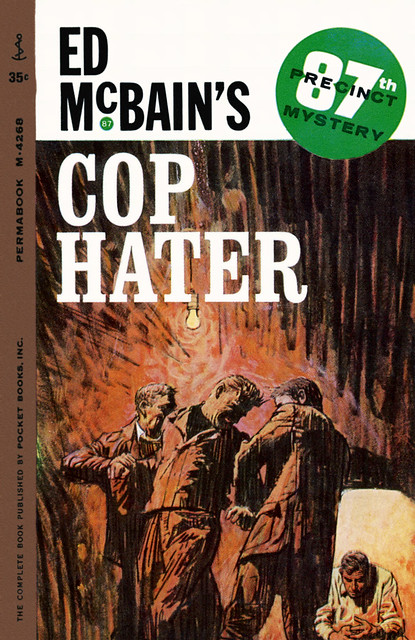
As described in this post The 87th Precinct Project, I'm trying to collect paperback editions of all of Ed McBain's wonderful 87th Precinct mysteries.

I thought it would be useful to post the full list so I can mark them off as I go. Titles in bold are ones that I have managed to track down.

I'll also re-note here the rules I'm sticking to:
1) Books must be softcover
2) Books must be secondhand
3) I'm not after first editions but the closer I can get to the original publishing date the better
4) My preference will always be to buy from a brick and mortar store. I'm only going to resort to the interwebs when I really start to struggle.


Cop Hater (1956)
The Mugger (1956)
The Pusher (1956)
The Con Man (1957)
Killer's Choice (1957)
Killer's Payoff (1958)
Lady Killer (1958)
Killer's Wedge (1959)
'til Death (1959)
King's Ransom (1959)
Give the Boys a Great Big Hand (1960)
The Heckler (1960)
See Them Die (1960)
Lady, Lady I Did It (1961)
The Empty Hours (1962) - collection of three short novellas
Like Love (1962)
Ten Plus One (1963)
Ax (1964)
He Who Hesitates (1964)
Doll (1965)
80 Million Eyes (1966)
Fuzz (1968)
Shotgun (1969)
Jigsaw (1970)
Hail, Hail the Gang's All Here (1971)
Let's Hear It for the Deaf Man (1972)
Sadie When She Died (1972)
Hail to the Chief (1973)
Bread (1974)
Blood Relatives (1975)
So Long as You Both Shall Live (1976)
Long Time No See (1977)
Calypso (1979)
Ghosts (1980)
Heat (1981)
Ice (1983)
Lightning (1984)
Eight Black Horses (1985)
Poison (1987)
Tricks (1987)
Lullaby (1989)
Vespers (1990)
Widows (1991)
Kiss (1992)
Mischief (1993)
Romance (1995)
Nocturne (1997)
The Big Bad City (1999)
The Last Dance (2000)
Money, Money, Money (2001)
Fat Ollie's Book (2002)
The Frumious Bandersnatch (2003)
Hark! (2004)
Fiddlers (2005)


Buy Sunliner for non-Kindle devices (iOS, Kobo, Sony Reader)
Buy Sunliner for Kindle (UK)
Buy Sunliner for Kindle (US)

Saturday, 2 June 2012

Elmore Leonard's 10 rules of writing and how badly I break them

I'm a huge fan of Elmore Leonard, the American crime and western writer, and read with interest his 10 rules of writing when I stumbled across them recently. I break many of them in Sunliner so reviewing them, especially when I admire Leonard's work so much, was something of a sobering experience.

Here they are, with notes to indicate how badly I've strayed from them.


 1. Never open a book with weather.
Phew - this one I didn't do.

 2. Avoid prologues.
Whoops - although in my defence the prologue was on the advice of someone who works in publishing and I think it works.

 3. Never use a verb other than "said" to carry dialogue.
This is a great one and something I'll definitely do in future...I really didn't in Sunliner though.

 4. Never use an adverb to modify the verb "said”…he admonished gravely.
Another black mark for me and Sunliner...

 5. Keep your exclamation points under control. You are allowed no more than two or three per 100,000 words of prose.
That ratio would mean I could have no more than 3 in Sunliner. Pretty sure it's more than that! Way more!!!

 6. Never use the words "suddenly" or "all hell broke loose."
Bollocks, I think I even have a "suddenly all hell broke loose"

 7. Use regional dialect, patois, sparingly.
I don't think I break this one, unless you count the 50s hardboiled style of speaking that everyone in the book uses as a regional dialect.

 8. Avoid detailed descriptions of characters.
I spend a bit of time describing JJ when we first meet him but not, I hope, too much.

 9. Don't go into great detail describing places and things.
Woohoo - I stuck to this one.

 10. Try to leave out the part that readers tend to skip.
I think (and hope) I managed this one. Unless my readers like to skip car chases.

I'm going to give myself 5 out of 10.
MUST TRY HARDER.


Buy Sunliner for non-Kindle devices (iOS, Kobo, Sony Reader)
Buy Sunliner for Kindle (UK)
Buy Sunliner for Kindle (US)

Thursday, 31 May 2012

The 87th Precinct Project

Over the years I've read and loved many (probably most) of Ed McBain's 87th Precinct novels.
For anyone who doesn't know them the books, written over 49 years (from 1956 to 2005) are police procedurals set in a fictional (and never named) city which bears many similarities to New York.
The books are all short (just right for a crime novel in my opinion), snappy and written with humour and a wonderful sense of character. Every one of them starts with the wonderful disclaimer:

The city in these pages is imaginary. The people, the places are all fictitious. Only the police routine is based on established investigatory technique.


I've just remembered that I used to have that photocopied and up on my bedroom wall. :)

I've owned a good few of them in my time but currently own none, having had a massive book clearout a few years ago. Recently I've had a hankering to read them again and, probably coincidentally, a desire to read physical books again after a couple of years reading ebooks almost exclusively. There's something about the feeling of a paperback in my back pocket that I miss.
These two notions conspired together in my brain and meshed themselves together into the idea that I should try and reacquire all of the books and reread them in order. Given that there are 54 of them (feel free to correct me on that but I think it's correct) and that I refuse to pay full price for any of them there's likely to be a bit of legwork involved in this quest, but no more than McBain's fictional detectives regularly indulged in.

I started this search just over a week ago, visiting every place that sells second-hand books in the town I live in and turning up not one of them.
Earlier this week I walked from work down to the main street and searched over a dozen charity shops with no luck. I did find one hardback copy of 'Mischief' but I'm only interested in paperbacks. I never said this project was logical. I was pretty dejected about the whole thing at that point and then today I got a message from someone with a copy of 'The Big Bad City' that needs a good home. This random act of kindness has got me into the whole idea again...

So that's what I'm doing and I'll post weekly updates for anyone who is interested...


Buy Sunliner for non-Kindle devices (iOS, Kobo, Sony Reader)
Buy Sunliner for Kindle (UK)
Buy Sunliner for Kindle (US)